search home
University of Cambridge Home Department of Experimental Psychology
University of Cambridge > School of the Biological Sciences > Department of Experimental Psychology > Research Groups

Image

Comparative Cognition Lab

Comparative cognition in animals

Cognitive development

Prof N S Clayton FRS (Head)
Professor of Comparative Cognition
Graduate Tutor and Director of Studies in Natural Sciences (Biological) for Clare College.
Tel: 01223 333559 Fax: 01223 333564 e-mail: n.clayton@psychol.cam.ac.uk

Image

Current topics in animal cognition include:

  • Mental time travel (episodic-like memory and future planning) by food-caching Western Scrub-Jays. This work is done in collaboration with Professor Tony Dickinson who is also in the Department of Experimental Psychology.
  • Crime, punishment and protection by food-caching corvids. This work is conducted in collaboration with Dr. Nathan Emery at Queen Mary College, University of London.
  • Social and physical cognition in corvids (members of the crow family, which includes jackdaws, rooks and jays), from studies of alliance formation and post-conflict behaviours in rooks, and food-sharing in jackdaws, to tests of what corvids understand about tools and other tests of folk physics. This work is conducted in collaboration with Dr. Nathan Emery at Queen Mary College, University of London
  • Comparative studies of cognition in corvids (jackdaws, rooks and jays) and apes (chimpanzees, orangutans and bonobos). This work is done in collaboration with Dr. Nathan Emery and Dr. Josep Call at the Max Planck Institute in Leipzig.

Current topics in development include:

  • Development of prospective cognition in young children. This work is done in collaboration with Dr James Russell who also works in the Department of Experimental Psychology.
  • Development of social cognition in young children. This work is also done in collaboration with Dr James Russell.

Current links include:

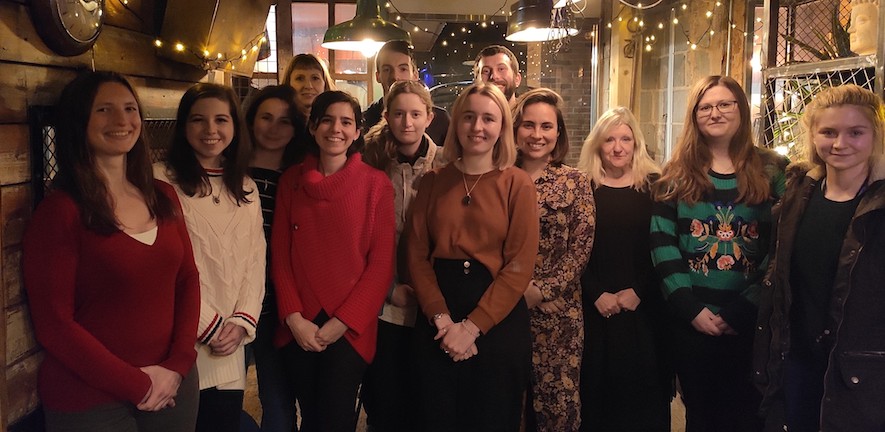
Lab Members

Cleo Buitendijk
Lucy Cheke
Sergio Correia
Dr Uri Grodzinski
Jolle Jolles
Corina Logan
Ljerka Ostojic
Dr Caroline Raby
Rachel Shaw
Dr Alex Taylor
James Thom
Elske van der Vaart
Allie Watanabe
lab members

We hold weekly lab meetings during term time on Tuesdays at 4.30 pm in the Craik-Marshall seminar room. These are also attended by Prof Tony Dickinson's and Dr Nathan Emery's groups, as well as by Prof Nick Mackintosh (Psychology, n.mackintosh@psychol.cam.ac.uk) and Prof Nick Humphrey (London School of Economics, n.humphrey@lse.ac.uk).

Profile Pieces

Recent sites

Some Recent Publications

Clayton, N. S. & Dickinson, A. (1998). Episodic-like memory during cache recovery by scrub jays. Nature 395, 272-278.

Clayton, N. S. & Russell, J. (2009). Looking for episodic cognition in animals and young children: prospects for a new minimalism. Neuropsychologia 47, 2330-2340.

Correia, S. P. C., Alexis, D. M., Dickinson, A. & Clayton, N. S. (2007). Western Scrub-Jays anticipate future needs independently of their current motivational state. Current Biology 17, 856-861.

Dally, J. M., Emery, N. J. & Clayton, N. S. (2006). Food-caching western scrub-jays keep track of who was watching when. Science 312, 1662-1665. 

Emery, N. J. & Clayton, N. S. (2001). Effects of experience and social context on prospective caching strategies in scrub jays. Nature 414, 443–446.

Emery, N. J. & Clayton, N. S. (2004). The mentality of crows. Convergent evolution of intelligence in corvids and apes. Science 306, 1903-1907.

Raby, C. R., Alexis, D. M., Dickinson, A. & Clayton, N. S. (2007). Planning for the future by Western Scrub-Jays. Nature 445, 919-921.

Russell, J. Alexis, D. M. & Clayton, N. S. (2009). Episodic future thinking in 3- to 5- year-old-children: The ability to think of what will be needed from a different point of view. Cognition. DOI: 10.1016/jcognition.2009.08.013

Seed, A. M., Emery, N. J. & Clayton, N. S. (2009). Intelligence in corvids and apes: a case of convergent evolution? Ethology 115, 401-420.

Stulp, G., Emery, N. J., Verhulst, S. & Clayton, N. S. (2009). Western scrub-jays conceal auditory information when competitors can hear but cannot see. Proceedings of the Royal Society of London Series B Biological Letters 5, 583-585.

Teufel, C. R., Alexis, D. M., Clayton, N. S. & Davis, G. G. (2009). Social Cognition Modulates the Sensory Coding of Observed Gaze-Direction. Current Biology 19, 1274-1277.

Science and Dance

Nicky is also a keen dancer and is fascinated by the links between science and dance. She is collaborating with Rambert Dance Company on a new work, 'The Comedy of Change', based on Darwinian principles to commemorate Darwin's 200th anniversary. See http://www.rambert.org.uk/comedy_of_change/mark_baldwin/marks_blog/on_the_origin_of_species
http://www.skyarts.co.uk/video/video-sky-arts-at-rambert-dance-company

Rambert Dance Company have just appointed Nicky to become the Company's Scientific Advisor.

lab members